The Three Corporate Principles-Corporate Responsibility to Society, Integrity and Fairness and International Understanding through Trade - established early on in our company's history, have served as our core philosophy, inspiring MC to continually improve the way we address our economic, environmental, and social responsibilities around the world. The relevance and importance of these principles have only increased as we have entered the 21st century and it is vital that we continue to develop new sustainable business practices. To help guide us in these endeavors, our Environmental Charter, established in 1996, sets out guidelines for the pursuit of our goals.
Mitsubishi Corporation supports the Universal Declaration of Human Rights (UDHR) and strives to promote human rights across our business operations.
All our employees are our ambassadors, and it is vital that they understand and follow the principles and ethics of our company. In addition to the Environmental Charter, the Mitsubishi Corporation Code of Conduct sets out codes of behavior based on local laws and global standards such as environmental laws and regulations, the UDHR and the ILO Core Labor Standards. The Code has been distributed to all our staff around the world in English and Japanese (and in other local languages where requested).
A safe and secure working environment is fundamental to business and is Mitsubishi Corporation's primary responsibility to its staff. To ensure that this responsibility is upheld, we continually seek to protect our personnel, property, information and corporate reputation from security threats. When and where high level security threats are identified in certain circumstances-for example, in times of social unrest or political turmoil-and where there is no acceptable alternative to manage risk, we may elect to employ armed guards. In such situations, all our security operations shall be in compliance with national legal requirements as well as international standards and will be in full support of the US/UK Voluntary Principles on Security and Human Rights.
The Three Corporate Principles
The Three Corporate Principles are the foundation of the vision and strategy for our commitment to corporate social responsibility.
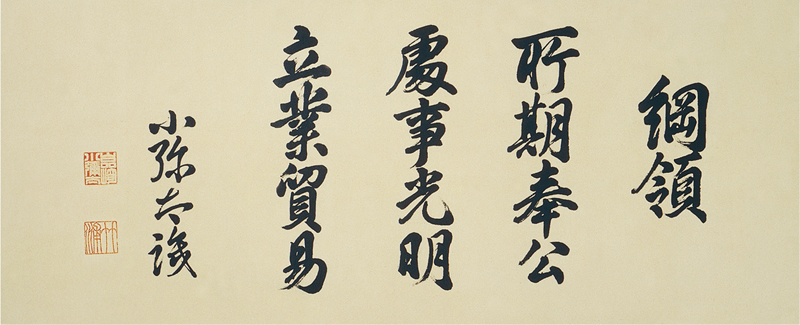
| Strive to enrich Society, both materially and spiritually, while contributing towards the preservation of the global environment. | |
| Maintain principles of transparency and openness conducting business with integrity and fairness. | |
| Expand business, based on all encompassing global perspective. | |
Corporate Standards of Conduct
Aim of Corporate Business Activities
Through its business activities, Mitsubishi Corporation will endeavor to increase its value. At the same time, the company will strive to enrich society in all ways, developing and offering its customers the best services and products, with the highest regard for safety.Fairness and Integrity in Corporate Business Activities
Mitsubishi Corporation will continue to develop its business activities in compliance with all relevant laws, international regulations and internal rules. The company will act responsibly and will respect the highest social standards.Respect for Human Rights and Employees
Mitsubishi Corporation will respect human rights and will not engage in any discrimination. The company will preserve and improve its corporate strengths through the development of its employees, all the while respecting the character and individuality of each employee.Information Security and Disclosure
While Mitsubishi Corporation will continue to develop, implement and improve the effectiveness of its information security management system, at the same time the company will disclose information accurately and in a timely fashion, so as to maintain transparency and be correctly understood by both its stakeholders and the general public.Consideration for Environmental Issues
Mitsubishi Corporation understands that an enterprise cannot continue to prosper without consideration for its environmental performance, and will strive to protect and improve the global environment and pursue sustainable development through all aspects of its business activities.Contribution to Society
As a responsible member of society, Mitsubishi Corporation will actively carry out philanthropic programs in an effort to promote the enrichment of society. Moreover, the company will support efforts of its employees to contribute to society.
Mitsubishi Corporation Code of Conduct
Basic Policy
All officers and employees of Mitsubishi Corporation (the "Company") must comply with all applicable laws, rules and regulations where they operate, international standards and rules, and all internal corporate rules and policies. In addition, all officers and employees of the Company must act in a socially responsible manner by complying with the highest ethical standards in the conduct of their business.
Basic Principles
- Respect human rights, and do not discriminate on any basis, and engage in any form of harassment.
- Maintain a high regard for environmental considerations in conducting our business operations, and ensure that our business is conducted in an environmentally sustainable manner, and comply with treaties, laws and regulations concerning the environment.
- Promote fair business practices and comply with trade rules, regulations, and internal corporate rules and policies.
- Comply with the rules and regulations of international trade.
- Protect and properly use confidential and proprietary information, protect the rights of the Company and respect the rights of others.
- Do not engage in insider trading.
- Avoid conflicts of interest with the Company; maintain a distinction between corporate and private business.
- Record and report accounting and financial information timely and accurately.
- Maintain proper legal and ethical standards with respect to gifts and entertainment.
- Resolutely oppose any organization, group or individual engaged in unlawful activities and do not provide money or other types of economic benefits to them.
- Promptly report to or consult the superiors, the Group Compliance Officers, the Domestic Branch Compliance Officers, the Foreign Regional Compliance Officers , the relevant departments, the Secretariat for the Compliance Committee, or the outside counsel in charge of Compliance upon discovering or committing any violations of this "Code of Conduct".
Mitsubishi Corporation Code of Conduct (Full text and related documents) (PDF:88KB)
Environmental Charter
At Mitsubishi Corporation we consider the Earth itself to be our most important stakeholder and are continually working towards the realization of a sustainable society through our business activities.
・ We will strive to reduce greenhouse gas emissions by continually implementing new efficiency measures and embracing new technologies.
・ We will promote the sustainable use of natural resources including energy, minerals, food stocks and water throughout our global business operations.
・ We recognize the critical importance of what ecosystems can provide and are committed to protecting ecosystems and mitigating any potential impacts on biodiversity.
・ We will strive to create and enhance environmental benefits by undertaking conservation activities and reducing our environmental footprint.
・ We will continue to actively engage and work with our various stakeholders openly and transparently and disclose information on the environmental impacts of our business operations in an appropriate and timely manner.
・ We will conduct all of our activities in compliance with environmental laws while adhering to international rules and social standards.
July 2010
Corporate Disclosure Policy
Mitsubishi Corporation (MC) is committed to fair disclosure based on applicable laws and regulations. Disclosure-related matters are handled in accordance with the policy shown below.
1. Information Covered by This Policy
This policy covers "material information" as stipulated by applicable laws and regulations. This includes information related to corporate decisions and occurrence of material fact as stipulated by the Tokyo Stock Exchange (TSE) in accordance with its policies for timely information disclosure and financial statements to be disclosed in accordance with laws such as the Japanese Commercial Code and the Financial Instruments and Exchange Law of Japan, as well as similar types of information.
2. Basic Principles Regarding the Disclosure of Material Information
MC discloses material information based on the following five principles:
Transparency:
MC discloses information in a factual manner, regardless of the content.Timeliness:
MC discloses information promptly, without delay, following occurrences that warrant disclosure.Fairness:
MC disperses information fairly to our various stakeholders.Continuity:
MC discloses information in a steady, continuous manner.Confidentiality:
MC does not provide information to third persons before information has officially been announced by the company.
3. The Structure and Role of the Disclosure Committee
The Disclosure Committee is chaired by the Chief Financial Officer. Vice chairs are Corporate Functional Officers in charge of the Corporate Communications Department, the Corporate Administration Department and the Legal Department as well as the Functional Officer in charge of internal audit and internal control. Certain General Managers from the Corporate Staff Section are also assigned to the Disclosure Committee. When needed, at the committee chair's discretion, related business group departments may be asked to join. A secretariat has also been established within the Disclosure Committee.
This committee debates corporate disclosure policy and shares material and related information. The committee also deliberates and authorizes the appropriateness of content and confines of disclosure related to items such as financial statements, quarterly reports and internal control reports, which are submitted as specified by the Financial Instruments and Exchange Law.
4. Framework for Disclosure of Material Information
The internal framework for disclosing material information (as described above) is as follows:
Timely Information Disclosure in Accordance with the Rules of the TSE
At MC, the executive officer in charge of corporate communications is responsible for the timely information disclosure, and he or she designates the general manager of the Corporate Communications Department to be the person in charge of managing information on a day-to-day basis. The Corporate Communications Department, as the department in charge of timely information disclosure, works to promote awareness regarding the importance of timely disclosure inside the company. At the same time, each department consults with the Corporate Communications Department about any decisions or occurrences that are thought to have bearing on the decisions of investors.
The general manager of the Corporate Communications Department proceeds to disclose information after discussion and deliberations with departments concerned regarding the necessity to disclose information and the content to be disclosed.Disclosure of Information Not Covered by the Rules of the TSE
Apart from the timely information disclosure stipulated by the TSE (as described above), MC also provides information as required by applicable laws and regulations. Various types of material information, such as those outlined below, are determined by executive officers and individual departments in charge after discussion and deliberation with other relevant departments, and information is then disclosed in accordance with applicable laws and regulations.- (1) Disclosure based on the TSE and listed security regulations (corporate governance report)
- (2) Disclosure based on the Financial Instruments and Exchange Law (financial statements, quarterly reports, internal control report, extraordinary reports, security registration statements and documentation related to issuances, etc.)
- (3) Disclosure based on the Japanese Commercial Code (business reports, account statements and consolidated account statements, and supporting schedules)
- (4) Disclosure based on regulations at overseas stock exchanges, etc. (annual reports, etc.)
5. Other
Market Rumors
In general, MC does not respond to inquiries regarding markets rumors. However in some case, MC may respond to a rumor when not responding could have serious ramifications for the company.
Note 1: In provision 158 of the Financial Instruments and Exchange Law, the spreading of market rumors is forbidden when offering a security, conducting any trade in a security or when attempting to impact the market fluctuation of a security.
Quiet Period
MC does not make statements regarding its financial outlook three weeks prior to the announcement of financial results (quarterly, or annual). However, exceptions may be made when there are occurrences of material fact that should be disclosed in accordance with the TSE's rules for timely information disclosure or extraordinary reports.
Note 2: During the quiet period, MC will refrain from attending to questions related to earnings, ensure fairness and prevent the leaking of earnings-related information. However, when there are events during the quiet period that may differ significantly from the company's announced earnings forecast, MC will disclose such information as appropriate. That said, MC will attend to questions during the quiet period regarding previously announced information.
Corrections to this Corporate Disclosure Policy
The Disclosure Committee must deliberate and authorize any corrections made to this Corporate Disclosure Policy. However, for minor corrections, the committee secretariat may make the corrections by attaining the approval of the Disclosure Committee chair.
(June 18, 2010)
Note: To read PDF files you need "
Adobe® Reader®". Click here to download this free software from the Adobe® website.

