
C-suites Unplugged:
Katsuya Nakanishi
From local markets to the boardroom, one global CEO explains why the age of the middleman is over – and why volatility is the ultimate opportunity
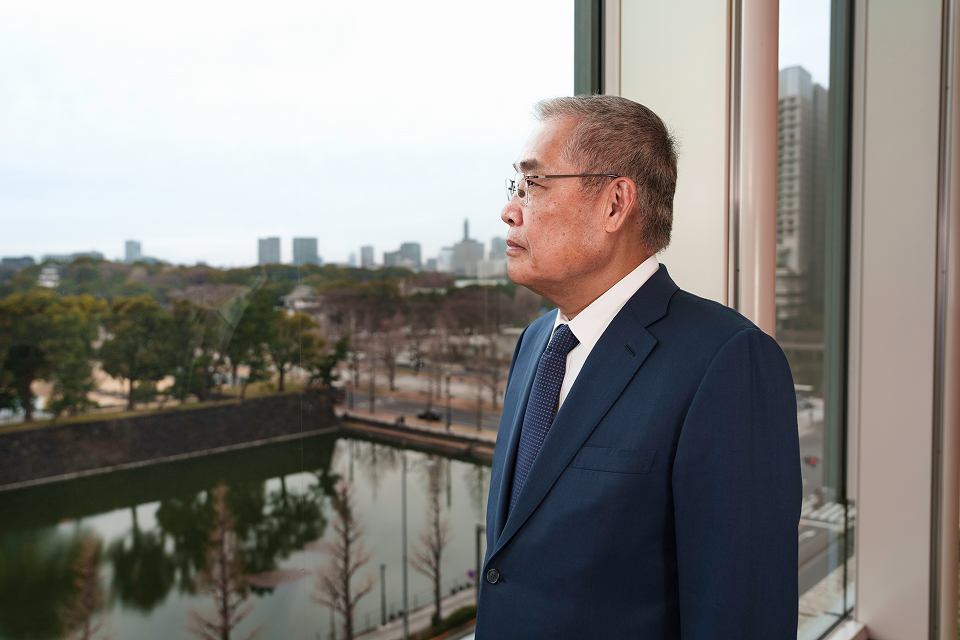
In a quiet meeting room in Tokyo overlooking the Imperial Palace, Katsuya Nakanishi leans back and reflects on how the meaning of trading house has changed.
“When I joined in 1985,” says Nakanishi, President and CEO of Mitsubishi Corporation, “we occupied the middle ground of the global supply chain as an intermediary, moving products from supplier to buyer.”
Trading alone, he explains, soon proved unsustainable. So, the Japanese sogo shosha, or general trading houses, diversified – investing in and operating businesses.
That shift, from trading to investment and business management, has defined Nakanishi’s four decades at Mitsubishi Corporation. “The company then and now may look similar on the surface,” he says. “But they are fundamentally different.” The term remains; the model does not.
A longing for scale
Nakanishi grew up in Osaka in a shopkeeping family. After university he entered a world of industrial scale: oil terminals, power plants and global commodity flows. The idea of working across continents appealed to him.
“I wanted to work globally. And I wanted to achieve something big,” he says. Postings in Bogotá, Mexico City, New York and Dubai followed. “The postings and business experience I’ve had in places now described as sources of geopolitical risk have been extremely helpful in how I manage and make judgments,” he says.
In Colombia, political risk became a lived reality. In Mexico during the Nafta years, he observed how the US border binds migration, narcotics and industry. From Dubai, he witnessed the effects of the 2015 Iran nuclear deal.
He later led energy and infrastructure projects, including Mitsubishi Corporation’s 2020 acquisition of Dutch renewable energy company Eneco.
From supply chain to value chain
When Nakanishi became President and CEO of Mitsubishi Corporation in 2022, he inherited 10 business groups. His rise through the energy infrastructure division, including as head of the Power Solution segment, shaped his view of electricity generation: a midstream business linking upstream resources and downstream customers, converting gas, coal and oil into energy.
Midstream may not be glamorous. But it connects upstream to downstream. And that, Nakanishi argues, is where strength lies. “Mitsubishi Corporation isn’t simply a collection of business segments,” Nakanishi says. “It is an integrated whole.”
He rejects the notion of a sogo shosha as a mere supply-chain broker. The ambition is to build value chains, owning and linking businesses and assets across stages. Its core strength is to combine what he calls a “menu” of capabilities – power, LNG, chemicals, food distribution and retail – into new solutions.
That approach was evident in January 2026, when Mitsubishi Corporation agreed to acquire Aethon’s shale gas business in the Haynesville formation in Louisiana and Texas, its first investment exceeding ¥1tn ($6.4bn).
The deal was about structure as much as scale. Mitsubishi Corporation has long operated power generation assets in the US, historically buying gas from third parties, converting it into electricity and selling it on. With upstream gas now under its control, it can link assets more deliberately: not only gas to LNG for export, LNG to Europe through Eneco, but also gas to power, power to data centres, and gas to chemicals. “We have our own gas, our own LNG facility, our own power plants,” he says. “We connect the chain.”
As demand rises from data centres and AI infrastructure, that flexibility matters. Natural gas, while not carbon-free, emits less CO2 than coal, and supports more flexible grids. The ability to direct molecules and electrons across borders is, in Nakanishi’s view, central to what a trading house, or what he prefers to call an “integrated value company”, is designed to do.
“It’s like individual cells forming a single body. Those elements reside within the body we call integrated strength,” he says. “They can include broad industry expertise, global network, intelligence, financial stability, talent base and trust. That is the message I most want to convey: let’s grow using that as the engine.”
Courage and change
Big deals require conviction. Nakanishi recalls the leap from his first ¥4bn ($25.6mn) investment to one worth ¥30bn ($192mn). “The courage required is completely different,” he says. Even when the final decision rested elsewhere, being the proposer meant owning the risk.
Nakanishi wants that culture to endure. The company’s human capital vision, branded DEAR (Diversity, Energise, Accelerate, Reward), encourages early-career employees to cultivate curiosity and expertise.
“Change creates opportunity,” Nakanishi says. AI, he argues, can act as a horizontal “skewer”, cutting across vertical silos such as logistics, retail, energy and finance.
Companies with multiple silos, he suggests, may be well placed to recombine them. That thesis has attracted investors, including Berkshire Hathaway, which holds more than 10 per cent of Mitsubishi Corporation as of March 2026, alongside stakes in four other Japanese trading houses. By taking a stake in five trading houses, Nakanishi suggests, Berkshire gains exposure to multiple internal portfolios and the combinations across them.
Given the breadth of Mitsubishi Corporation’s operations, communication with stakeholders - from global institutional investors to retail investors in Japan – has become increasingly important.
“Through investor days, we engage in opportunities to communicate our strategy as clearly as possible,” Nakanishi says. He cites Japan’s new NISA scheme, a revamped tax-exempt investment programme, as one factor driving increased retail participation.
“Given the diversity of our businesses, our portfolio can sometimes be perceived as complex,” he continues. “By providing careful explanations, investors gain a deeper understanding of the company, which in turn supports long-term shareholding.”
Earning it on the ground
Despite the talk of algorithms and asset classes, Nakanishi returns to where he began: experience.
“In the AI era, answers pop out immediately,” he says. If research that once took hours now takes minutes, the time saved should be spent in the field. Quoting a Japanese idiom, he adds: “To earn things with your own feet, to feel things with your own skin - that is what matters.”
For a leader whose worldview was shaped amid unrest in Colombia, border politics in Mexico and boardrooms across Europe, that mentality is not nostalgia. It is operating doctrine.
and produced in partnership with the Financial Times Commercial department.