Why Flexibility Flourishes in the Face of Unexpected Challenges

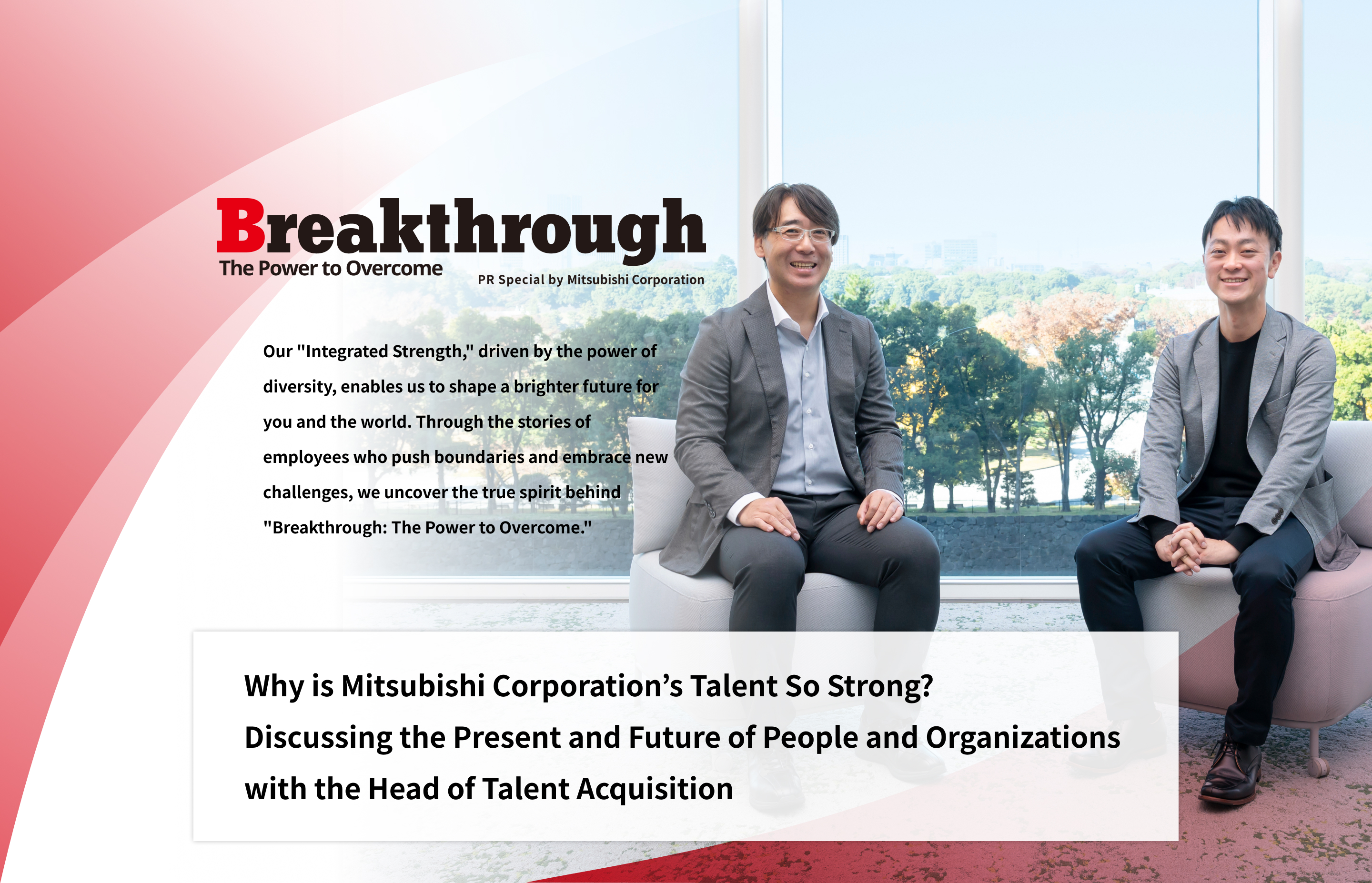
TamakawaAfter interviewing five MC employees, I was struck by their exceptional ability to handle unexpected challenges and unpredictable situations. For instance, in our first interview, Masayuki Nishimura carved out his own role during a secondment in Norway by proactively earning the trust of those around him. In the second, Noriko Kishikawa took decisive action to protect jobs when the COVID-19 pandemic struck just as a new airport in Mongolia was about to open. In each case, they responded flexibly to immediate challenges and steadily delivered results. How is this remarkable adaptability developed?
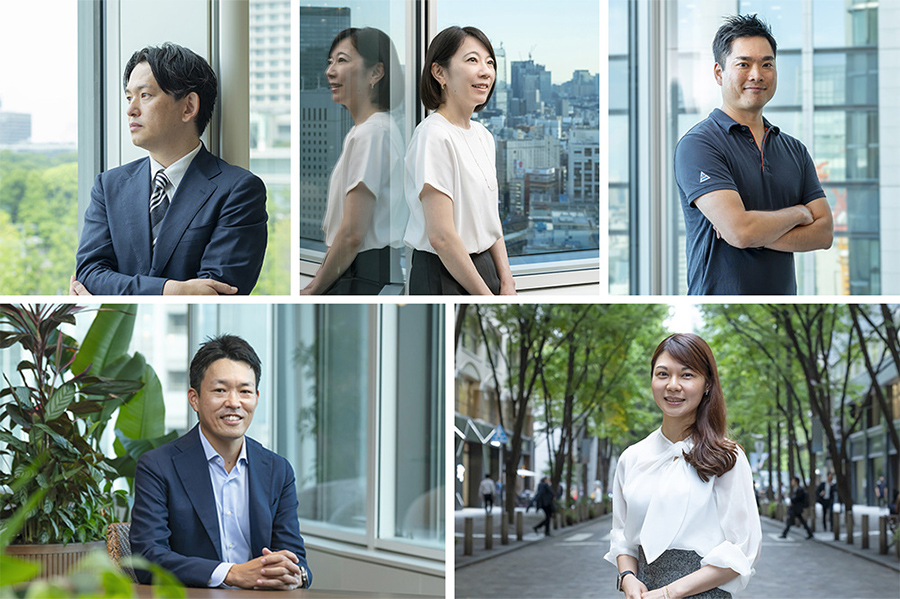
YoshikiI believe it largely stems from gaining diverse, hands-on experience in the field from an early stage. At MC, many employees are placed on the front lines early in their careers under a "just give it a try" philosophy, taking on a wide range of responsibilities. They are expected to think and act for themselves—to identify current issues and determine what needs to be done.
You try things out, learn from failure, and gain insights from the advice of supervisors and senior colleagues, as well as from customers’ reactions. By repeating this cycle, employees gradually develop their own professional methods and core principles. Because each individual continues refining this core as their career progresses—while confronting diverse day-to-day operations—they are able to respond flexibly even when faced with the unexpected.
TamakawaSo it all begins with a willingness to try, even if there’s a risk of failure.
YoshikiExactly. In fact, within the company, saying nothing and doing nothing is generally viewed more negatively than trying and failing.
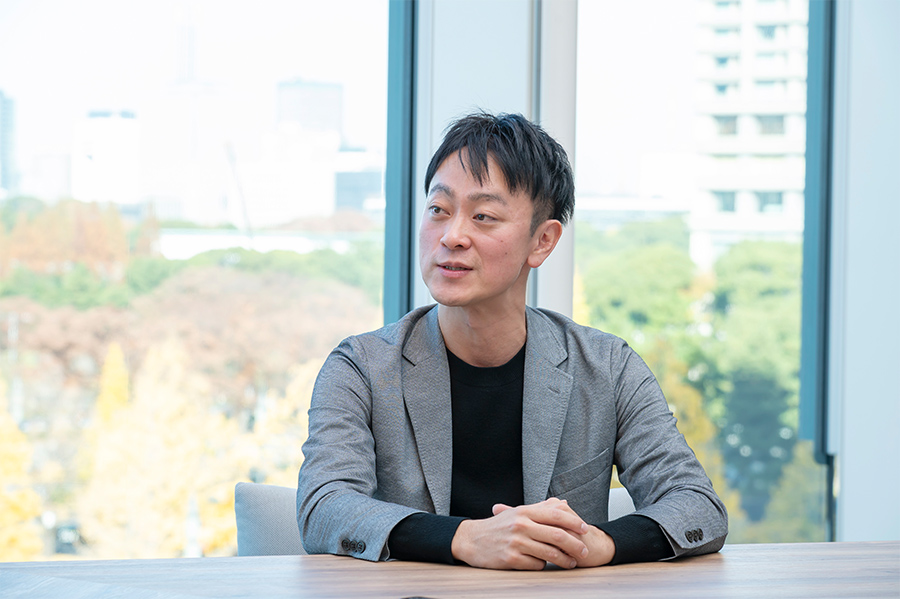
TamakawaHave you personally experienced unexpected trouble, Mr. Yoshiki?
YoshikiOf course—countless times. Before joining the Global Human Resources Department in 2024, I worked in the aerospace business. In my first year, while handling trading operations, I was informed that a component from an overseas manufacturer would be delayed. If MC fails to deliver on time, it affects not only our direct customers but also their customers down the line, potentially damaging our credibility. Naturally, it can also involve substantial penalties.
TamakawaIf that had happened to me in my first year, I would have panicked (laughs). How did you handle it?
YoshikiI felt enormous pressure at the time and thought, "This is a disaster." However, I wasn't dealing with it alone. The entire team, including my manager and senior colleagues, worked together to identify the cause and determine our next steps. We explored every possible option. Could we use an existing part as a substitute? Could we switch suppliers? Could a shipment intended for another country be redirected to Japan? Through these efforts, we ultimately managed to meet the deadline.
Looking back on my early years at the company, I realize how fortunate I was with my supervisors and senior colleagues. Many of them led by example rather than providing step-by-step instructions. I worked desperately just to keep up with them, and that experience shaped me profoundly.
Strong Organizations Are Built from Strong Individuals
TamakawaBuilding on your earlier point, I sensed a shared commitment among all the employees to valuing teamwork and collaboration when solving complex problems. For example, in the fourth interview, Shunsuke Kusano succeeded in developing a major hit vehicle in Indonesia through outstanding teamwork that transcended borders and organizational boundaries.
YoshikiIt’s widely known that MC places great importance on achieving results as a team and as an organization. This focus on teamwork is sometimes misunderstood to imply that individuals aren't particularly strong, or that MC is a top-down organization where it’s difficult to speak up, but that isn't the case at all.
In reality, we bring every individual opinion to the table, discuss them thoroughly, determine the best course of action as an organization, and then move forward as one team. I believe that it is precisely because we are an organization of strong individuals that we are able to demonstrate collective strength and achieve results.
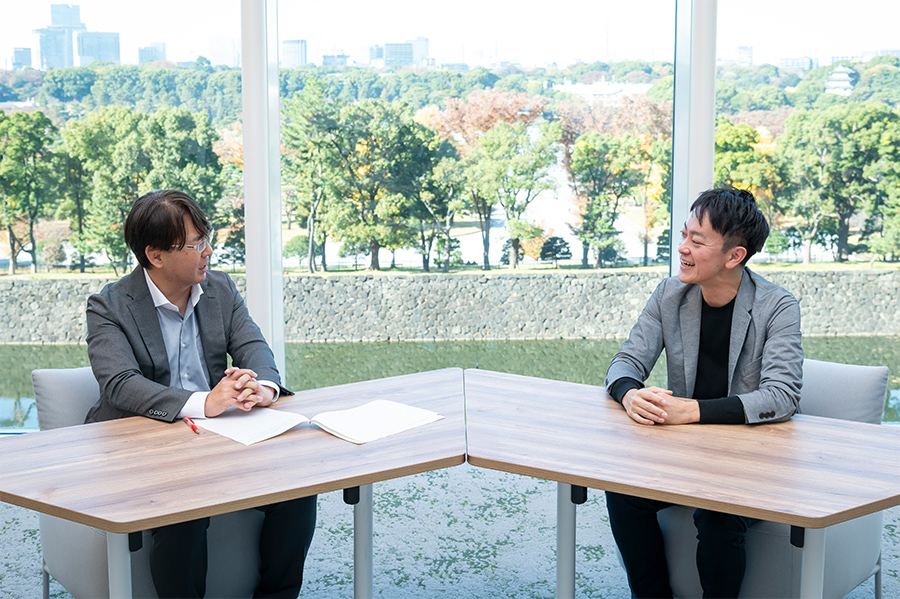
TamakawaThe employees’ relentless challenging spirit was also impressive. Furthermore, it seems that people on the front lines are entrusted with a great deal of discretion. Given the scale of MC’s business, I had expected decisions to rely more heavily on Head Office direction, so this came as a surprise.
YoshikiAt MC, the underlying premise is that employees in the field are the ultimate professionals and the primary drivers of the business. Those closest to the action are the first to sense changes in the business environment and to understand the perspectives of various stakeholders. Therefore, we place great importance on how on-site teams think and act. The Head Office and managers of each organization play a different, but equally vital, role. They set direction and vision, make course corrections when necessary, and provide insights from different perspectives.
TamakawaHave you also had the experience of making major decisions in the field?
YoshikiYes. For example, while I was stationed in Washington, D.C., I was responsible for negotiating contract terms between Japanese and U.S. manufacturers. With less than two days remaining before the deadline, negotiations broke down, and a project worth 90 billion yen (around USD 600 million at the time) was on the verge of being scrapped.
Because time was so limited, I coordinated with Tokyo but ultimately made the decision to contact the head of a division at the U.S. manufacturer directly for a one-on-one negotiation. I’m sure they thought, "Who is this kid?" (laughs). Still, I conveyed, as earnestly as I could, the importance of the contract and the fairness of the proposed terms, and we were able to close the deal. Looking back, it was an extremely nerve-wracking situation, but the outcome was only possible because of the understanding and efforts of all parties involved, as well as the trust we had built over time.
TamakawaWhen I was a reporter covering the Ministry of Foreign Affairs, I once asked what defines an excellent diplomat. The answer was, "Someone who can act autonomously and deliver a timely home run when something happens, without asking headquarters every single time." That description seems to resonate strongly with MC employees working on the global front lines.
Guided by the Question: "Does This Benefit Society?"
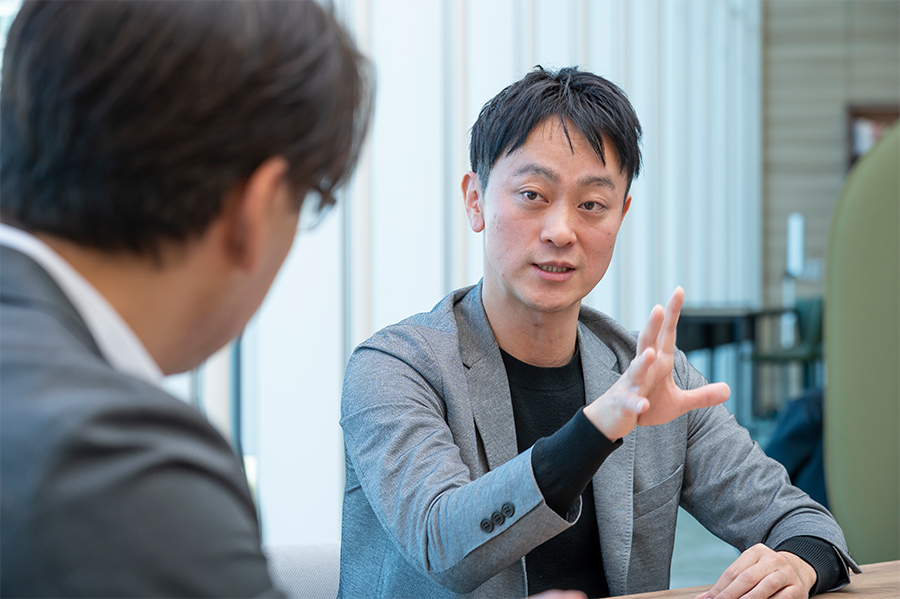
TamakawaIn the third interview, Ryo Hoshide was working on a large-scale LNG (liquefied natural gas) value chain project spanning Canada and East Asia. LNG is an energy source that supports the transition to a decarbonized society. I was impressed by his ability to conceptualize the business from multiple perspectives, including negotiating agreements with partners. Above all, I sensed a strong mission-driven mindset, a belief that "this project is necessary for the world and for the future."
YoshikiI believe MC employees share a strong awareness of working for the benefit of society. Like myself, everyone who joins the company resonates deeply with the Three Corporate Principles (*). Our corporate stance is to create a positive impact on the world through our business and to contribute to solving social issues—essentially viewing "business" and "realizing a better society" as inseparable.
This mindset is a point of pride for MC and is firmly rooted among our employees. For instance, when deciding whether to proceed with a particular business initiative, discussions often center on questions such as, "Is this aligned with the Three Corporate Principles?" and "Is this something MC should be doing?"
TamakawaSo, by having the Three Corporate Principles as a compass, you can return to them when faced with uncertainty. I felt that keeping these values at the core allows MC to move the business forward without wavering, even in challenging situations, such as balancing the interests of multiple companies or building trust across different countries and cultures.
* The Three Corporate Principles
Formulated based on the teachings of Koyata Iwasaki, the fourth president of Mitsubishi, the Three Corporate Principles are: Shoki Hoko (Corporate Responsibility to Society), Shoji Komei (Integrity and Fairness), and Ritsugyo Boeki (Global Understanding Through Business).
In their modern interpretation, these principles mean:
● Striving to enrich society, both materially and spiritually, while contributing to the preservation of the global environment.
● Maintaining principles of transparency and openness, conducting business with integrity and fairness.
● Expanding business, based on all-encompassing global perspective.
These principles serve as the foundation for every MC employee as they develop business and fulfill their responsibilities to the environment and society.
Proactive Career Development: "The Work I Want to Do"
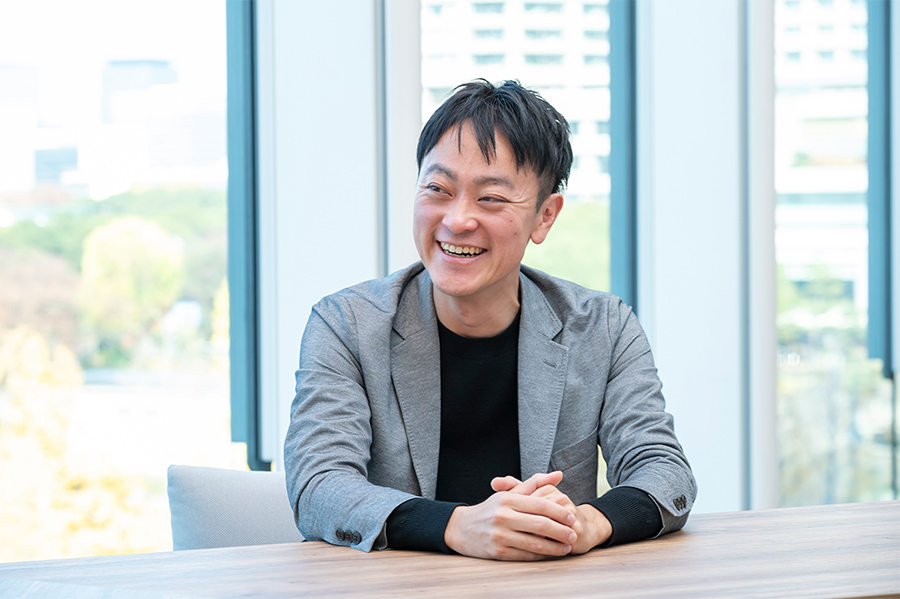
TamakawaLooking at the career paths of the people I've interviewed, I noticed that many of them have experienced multiple transfers. In the fifth interview, for example, Eri Fujii is currently working on a new medical tourism business while maintaining her core expertise in IT and digital transformation. In the fourth, Shunsuke Kusano has worked in different locations, including Indonesia, Japan, and Vietnam, and in different roles, even while remaining within the same Mobility Group.
YoshikiMC’s HR policy emphasizes growth through experiencing diverse types of work, so job rotation is the norm. Career breadth expands significantly depending on the combination of industries or sectors a group is involved in; work locations such as domestic offices, overseas offices, or operating companies; organizational affiliation, including Head Office or branch offices; and specific duties such as trading, business development, investment, or management.
As seen in the interviews, it is not unusual for roles, positions, and stakeholders to change dramatically through transfers. While these changes can involve conflict and hardship, they also create valuable opportunities for growth by exposing employees to diverse perspectives and values.
TamakawaI was also struck by the high level of motivation toward career development—the constant awareness of self-transformation. Are there specific systems in place to support this?
YoshikiRegular dialogue between employees and the company plays a key role. For example, we conduct "Growth Dialogues" with supervisors to discuss skill and career development, and employees also have opportunities to speak with talent management representatives in each department. These conversations help ensure the right person is placed in the right role. During these talks, employees can openly express their interests, such as "I want to try this next" or "I want to work in that department," and in some cases, these requests are reflected in actual assignments.
In my own case, I requested a transfer to the Corporate Staff Section to broaden my career perspective, which ultimately led to my current role. Working to support employee growth from a company-wide perspective has been an invaluable learning experience. While contributing in this capacity, I hope to fully leverage the experience and knowledge I’ve gained in Corporate when I eventually return to the sales front lines.
Leveraging, Nurturing, and Rewarding Diverse Talent
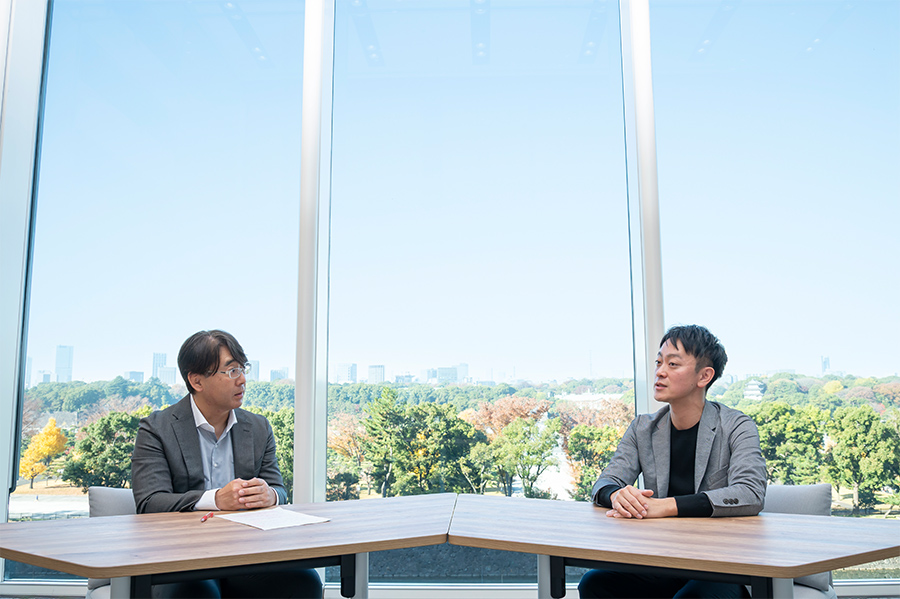
TamakawaPlease tell us about recruitment. Ryo Hoshide joined MC at age 36 after earning an MBA and working at a securities firm. Are you placing greater emphasis on mid-career recruitment?
YoshikiIn anticipation of changes in the business environment, we have been actively pursuing mid-career recruitment in recent years. We have high expectations that mid-career hires will bring a fresh perspective as immediate contributors, making use of the knowledge and experience they gained outside MC. We also recruit what we call "second new graduates," those with up to three years of work experience. To ensure that mid-career hires integrate smoothly, we have put support systems in place, including one-on-one follow-ups with advisors in their departments, training in skills such as AI and bookkeeping, and lectures on internal systems and workflows.
TamakawaIn the fifth interview, Eri Fujii made use of MC's re-employment system for employees who leave due to a spouse’s transfer, returning after a three-year break. Losing valuable talent due to life events is a major loss for any company, so this seems like a flexible system that benefits both the individual and the organization.
YoshikiIn fact, my own supervisor returned to MC through this re-employment system and is now Senior Vice President and General Manager of the Global Human Resources Department. In addition, we offer a variety of systems to support the balance between career and life events, including childbirth, childcare, and eldercare.
TamakawaAmidst rapid changes in the business environment and increased labor mobility, are there any new initiatives in talent management?
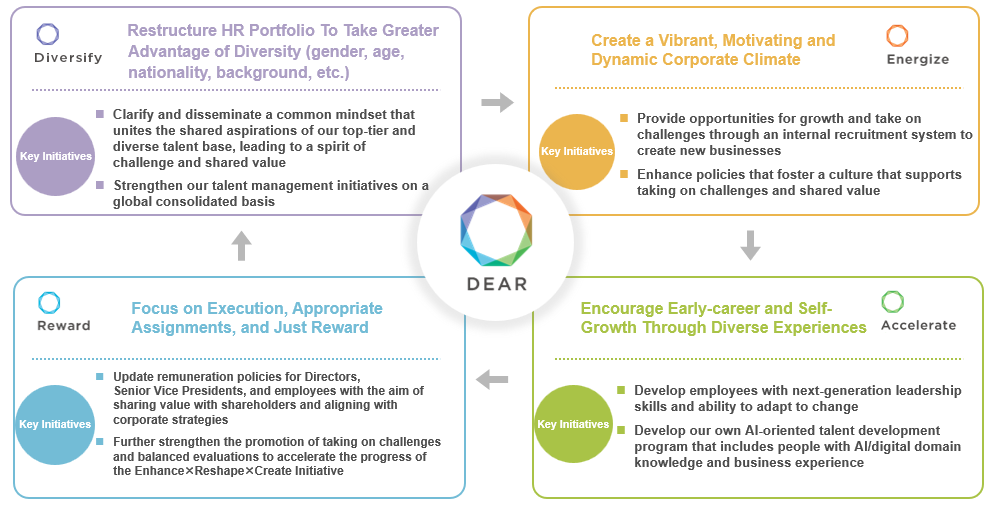
YoshikiAt MC, we are currently advancing the "MC HR Vision 'DEAR'", which looks 10 years into the future. DEAR stands for Diversity (diverse and talented people), Energize (leveraging talent), Accelerate (nurturing talent), and Reward (rewarding talent). The vision is to attract diverse talent regardless of gender, nationality, or background, and to create an environment where everyone can work with enthusiasm, take on challenges, and feel a sense of personal growth. Ultimately, our goal is to link the growth of each employee to the growth of the company as a whole.
To that end, we are implementing concrete measures, such as aiming for more than 30 percent female representation at all levels and identifying and developing talent capable of taking on roles that are both highly important and highly demanding.
Enjoy the Challenge, Even in Tough Times
TamakawaEveryone I spoke with is highly engaged in their work, but they also seem to enjoy their time off—whether it's soccer, tea ceremony, fishing, or skiing. They appear to switch very naturally between "on" and "off."
YoshikiThat’s true. Many employees share the mindset, "I work hard, play hard." Personally, when I'm off, I completely disconnect from work. I go camping with my family or play basketball with my child. Running about five kilometers in the park every morning is also a great way to refresh.
TamakawaThere must be many tough situations. Do you have a secret to overcoming them?
YoshikiSomething a senior colleague once told me, and that I still value today, is: "You must enjoy your work." In reality, there are plenty of difficult issues and pressures. There were times when I honestly thought I might get an ulcer (laughs).
Still, I try to face each situation with the mindset of enjoying even the difficult parts. I treat every experience, including failures, as fuel for the next challenge. By repeating this process, you develop the grit to persevere and finish what you started, which leads to growth. When you feel that growth, you gain confidence, and work becomes even more enjoyable. That cycle is what has kept me going.
TamakawaIt’s also reassuring that even in a crisis, challenges are faced as a team rather than alone.
YoshikiYes. At the end of each of the five interviews, there is a Self-rating Sheet, and you can see that everyone has their own peaks and valleys. No one is perfect; everyone has strengths and weaknesses. By complementing one another and leveraging individual strengths—such as being skilled at building customer relationships or excelling at detailed analysis—we are able to deliver results as a team. That is one of our greatest strengths.
TamakawaFinally, do you have a message for those who hope to join Mitsubishi Corporation?
YoshikiOur current recruitment website features the message "Curiosity that Moves the World." Every major business begins with a small spark of curiosity. I hope people will approach events in the world with curiosity and imagine, "I want to create this kind of society," or "I want to change the world in this way." We look forward to working with those who have the passion to turn that vision into reality with their own hands.
