Message from our CFO
1. Strategic Priorities as CFO
Following my appointment as CFO in April 2026, I am pleased to share my strategic priorities.
Since joining MC in 1991, I have spent much of my career in finance and accounting, while driving value creation at both the corporate and operational levels. My tenure includes transforming our business management framework in the Corporate Strategy & Planning Department and steering business turnarounds of our operating companies.
Among these experiences, spearheading the operational turnaround of a key operating company served as a defining milestone in my career. At the time, the business faced severe financial constraints that posed a threat to its ongoing operations.
Tasked with developing and executing the turnaround plan, I worked directly alongside employees across the organization, working beyond the boundaries of my own expertise. By building trust through direct and sustained engagement with each member of the team, I learned the importance of advancing change together. That experience shaped the principle that continues to guide me today: even when no clear path forward is visible, I remain closely engaged with the business, take the initiative, and continue pursuing the best possible solutions.
Over the 35 years since I joined MC, our market capitalization has increased approximately eightfold. This growth reflects both the broader expansion of Japan’s equity markets, supported in part by governance reforms led by the Tokyo Stock Exchange, and MC’s efforts to strengthen its earnings base through continued portfolio transformation and growth investment in response to changes in the business environment. It also reflects the recognition of these efforts by our shareholders and investors, as well as their expectations for MC’s continued growth. I am deeply grateful for their continued support and acutely aware of the responsibility I am assuming as CFO.
No business can be expected to remain a core earnings driver indefinitely. To enhance corporate value on a sustained basis, we must continually assess our existing businesses, reallocate capital from underperforming businesses, and continue investing in future growth. As CFO, I will support MC’s sustainable growth through disciplined capital allocation that balances near-term returns with medium to long-term value creation. I will also communicate clearly and transparently with our stakeholders, foremost among them our shareholders and investors, regarding the actions we are taking to enhance corporate value.
2. Achieving Corporate Strategy 2027
(1) Corporate Strategy 2027 (CS 2027) Progress
Under CS 2027, we aim to deliver further growth and improve capital efficiency through our “Enhance” and “Reshape” initiatives for existing businesses and our “Create” initiatives for new businesses.
In FY2025, the first year of CS 2027, we advanced a range of measures to Enhance and Reshape our existing businesses. Under Create, we decided to invest in a Haynesville shale gas business (Adamas Energy), which represents MC’s largest investment to date. Together, these actions marked meaningful progress toward realizing CS 2027.
In FY2026, the second year of CS 2027, we expect an approximately ¥150 billion increase in adjusted consolidated net income, excluding the contingency for developments in the Middle East. This increase reflects not only the benefit of higher resource prices, but also the earnings contributions beginning to materialize from our Enhance, Reshape, and Create initiatives. These include increased production at LNG Canada, the full consolidation of Mitsubishi Shokuhin following its conversion into a wholly owned subsidiary, and the initial earnings contribution from the shale gas business.
Through the execution of these initiatives and the implementation of the segment ROE framework, the foundations for achieving FY2027 targets of ROE of at least 12% and average annual growth of at least 10% in underlying operating cash flow are steadily falling into place. Our focus during the remainder of the CS 2027 period will be on translating these initiatives into tangible results.
(2) Enhance and Reshape Initiatives
Under Midterm Corporate Strategy 2024, we focused on improving profitability and accelerating portfolio transformation among businesses that were not meeting their required rates of return or had limited growth prospects, an approach we refer to as “Enhance 1.0.” Under CS 2027, we have expanded this approach by applying Enhance initiatives to all approximately 220 operating companies, including those already meeting their required rates of return, with the aim of further strengthening their profitability and growth prospects, or “Enhance 2.0.”
Amid heightened uncertainty arising from geopolitical risks and changes in the macroeconomic environment, we believe it is particularly important to maximize the competitiveness of our existing businesses and steadily expand their earnings. In fact, Enhance and Reshape are expected to account for the largest share of earnings growth during the CS 2027 period.
In the first year of CS 2027, we established three-year quantitative targets for all operating companies. The President and CEO and other members of senior management then conducted a series of Enhance and Reshape reviews with each business segment.
Through these reviews, we assess each company’s business plan from the perspective of improving profitability and capital efficiency, taking into account changes in the external environment and the company’s competitive advantages. We also examine the potential for further value creation and discuss specific growth strategies, including industry consolidation and bolt-on investments.
This fiscal year’s discussions centered on the recovery outlook and productivity enhancement measures in our core salmon farming and ASEAN automotive businesses. In our food distribution and logistics businesses, the use of AI and data analytics to optimize ordering, together with stronger product development capabilities, has begun generating measurable results. These engagements clearly demonstrate how frontline innovation is strengthening our earnings base.
At the same time, certain companies continue to face challenges, particularly where progress has lagged expectations.
For these companies, senior management has required specific improvement measures to be implemented within clearly defined time frames, and we will closely monitor progress throughout the year.
Under Reshape, we use these discussions to review potential M&A transactions that could contribute to industry consolidation, as well as opportunities to enhance business value through changes in capital structure or ownership. This enables senior management to become involved at an early stage.
Capital recycling is also an integral part of our approach to Enhance and Reshape. The principles of our Value-Added Cyclical Growth Model are now firmly embedded across the Company. For businesses that do not meet our required rates of return or continue to deliver limited growth, we seek to enhance their value.
If we determine that value enhancement through capital policy measures would be difficult, management maintains the discipline to consider divestiture as a potential course of action.
To achieve CS 2027, it is essential that we strengthen management’s involvement in our existing businesses, reinforce our earnings base, and accelerate portfolio transformation. I will remain closely involved in this process to strengthen the likelihood of achieving our targets.
(3) Achieving CS 2027 and Future Outlook
As we move toward FY2027, we expect to realize the benefits of projects already executed, together with the results of initiatives to strengthen the earnings base of our existing businesses. This progress gives me confidence in our ability to achieve our quantitative targets.
However, our FY2027 ROE target of at least 12% is a milestone rather than an end point. We must continue to improve capital efficiency over the medium to long-term.
It is also essential that we build a business foundation capable of supporting sustainable growth over the next 20 to 30 years. Our current large-scale investments, new business development, and portfolio transformation are not intended solely to generate nearterm earnings. Our decisions take into account the time horizon, geography, and business area, with the objective of developing the next generation of core earnings drivers that can support both growth and improved capital efficiency over the medium to long-term.
3. Addressing Key Capital Market Priorities
(1) Initiatives to Improve Capital Efficiency
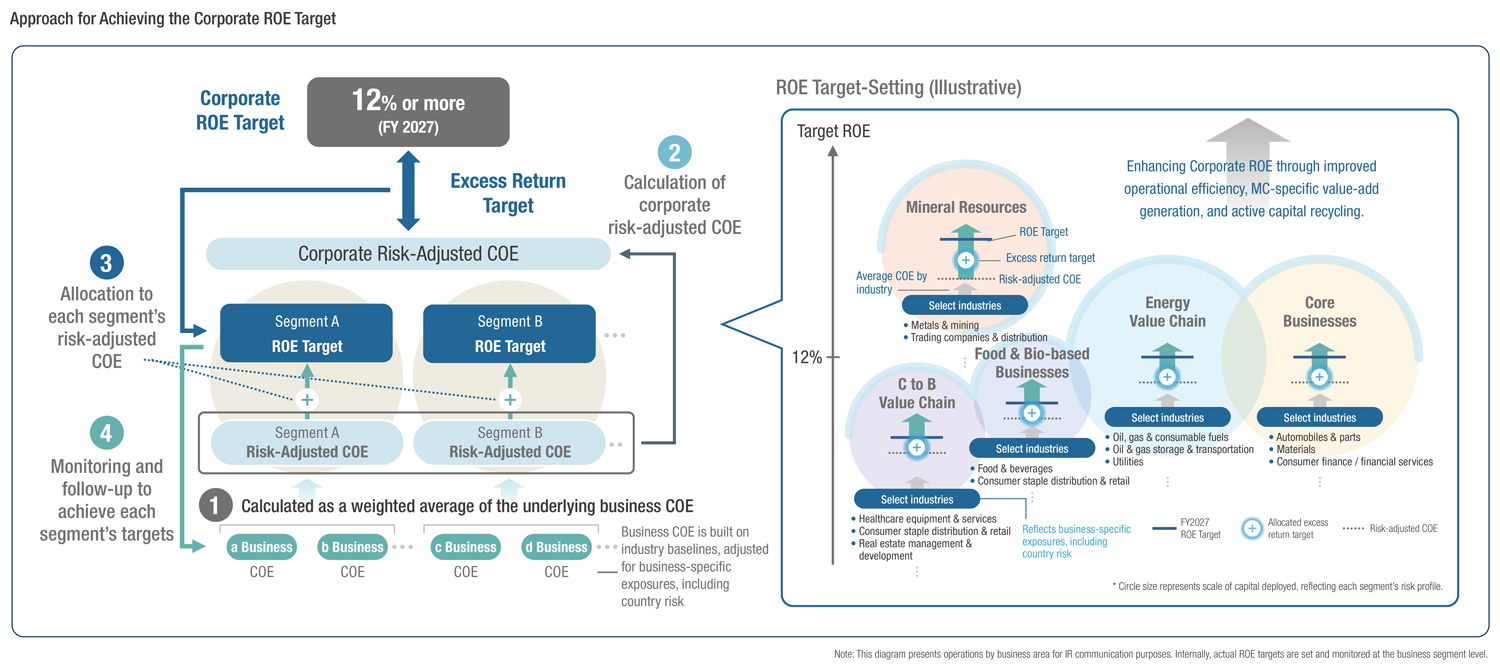
Based on CAPM, we estimate our cost of equity to be approximately 8% to 10%. In setting our CS 2027 ROE target of at least 12%, we sought not merely to exceed our cost of equity, but also to reflect the level of returns expected by the capital markets.
To deliver on this corporate ROE target, we have established individual ROE targets for each business segment. Operationally, we establish segment-specific rates of return by adjusting sector-average targets for localized risk exposures (such as country risk), establishing a baseline cost of equity for each business.
We then allocate to each business segment a portion of the excess return required to achieve our corporate ROE target, based on the difference between our corporate risk-adjusted cost of equity and our ROE target. This process forms the basis for each segment’s ROE target.
To achieve these targets, each business segment independently considers its own portfolio optimization.
Additionally, through Enhance and Reshape initiatives for the businesses in each segment, the objective is not merely to exceed the average required rate of return for the relevant industry, but to generate and expand returns above that threshold.
Recognizing capital efficiency as a continuing management priority, we have introduced this business management framework and other mechanisms to strengthen operations.
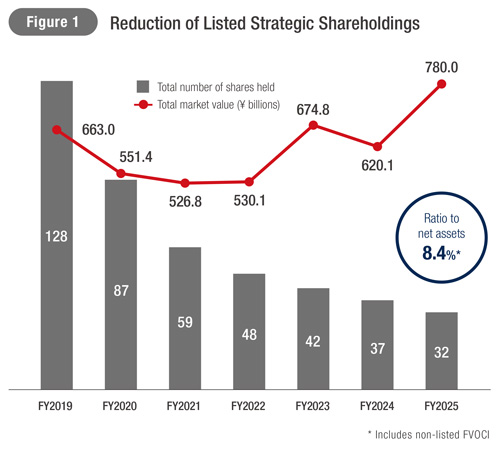
We also continue to regard the reduction of listed strategic shareholdings as an important management priority. This is also a key area of focus under Japan’s Corporate Governance Code, which was revised this year for the first time in five years. Each year, the Board of Directors assesses every listed strategic shareholding from the perspectives of both economic rationale and strategic significance.
Over the three years from FY2023 to FY2025, we reduced these holdings by around ¥0.1 trillion on a market value basis. As of March 31, 2026, our non-consolidated portfolio of listed strategic shareholdings (including indirect holdings) comprised 32 stocks, valued at approximately ¥0.8 trillion, representing around 8.4% of net assets (see Figure 1).
Moving forward, we will continue proactively divesting positions where strategic rationale for holding them has diminished, while prudently navigating prevailing market conditions.
(2) Capital Allocation and Shareholder Returns
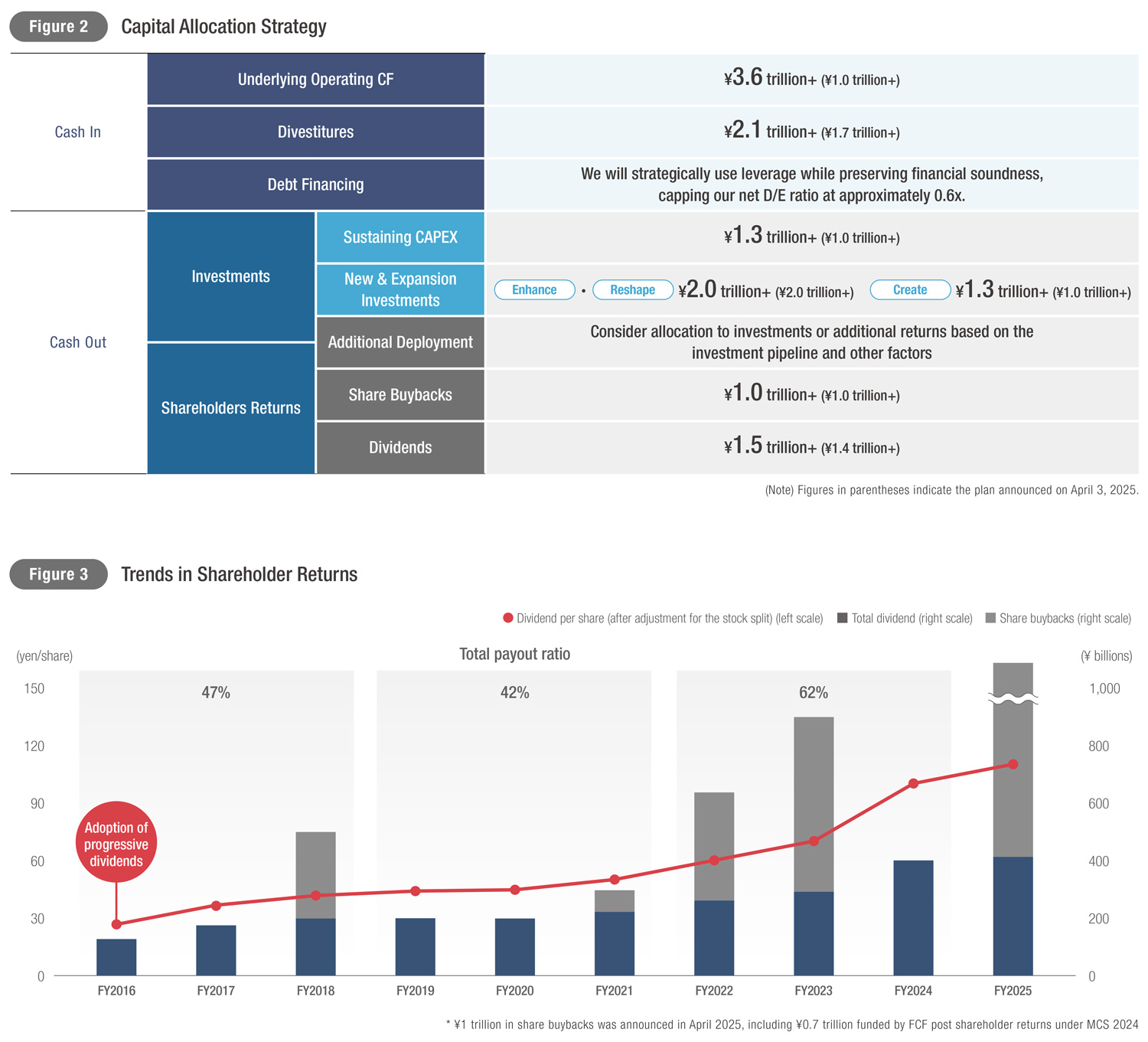
Progress in our Enhance, Reshape, and Create initiatives has given us greater visibility into continued earnings growth. Accordingly, we have decided to maintain our progressive dividend policy and increase the annual dividend by ¥15 per share from FY2025.
We recognize the market’s view that our dividend yield has become less competitive relative to the TOPIX following the rise in our share price. However, our dividend decisions are based not only on the prevailing dividend yield, but also on the expected trajectory of future earnings and the degree of visibility into that growth under our progressive dividend policy.
In addition to the dividend increase, and in light of the solid performance of underlying operating CF, accelerated investment recoveries, and our investment pipeline, we have revised the capital allocation plan set out in CS 2027, increasing our planned cash inflows and outflows by ¥0.7 trillion each (see Figure 2).
We will continue to strengthen cash generation by growing underlying operating CF and through capital recycling. At the same time, we will make disciplined use of leverage while maintaining financial soundness. We will deploy any excess capital capacity flexibly toward growth investment and shareholder returns as we pursue both growth and capital efficiency.
As CFO, I am firmly focused on achieving our CS 2027 quantitative target of ROE of at least 12% in FY2027. Our first priority is to allocate capital to growth investments that expand earnings, the numerator in the ROE calculation. At the same time, we will continue to evaluate the most effective combination of capital allocation measures, including the appropriate balance between growth investment and share buybacks.
Regarding share buybacks, we will continue to take a flexible approach, considering developments in our investment pipeline and overall capital allocation priorities.
We will continue to engage actively with the capital markets, including by providing clear and transparent updates on the execution of our capital allocation strategy.
4. Sustainable Growth Initiatives
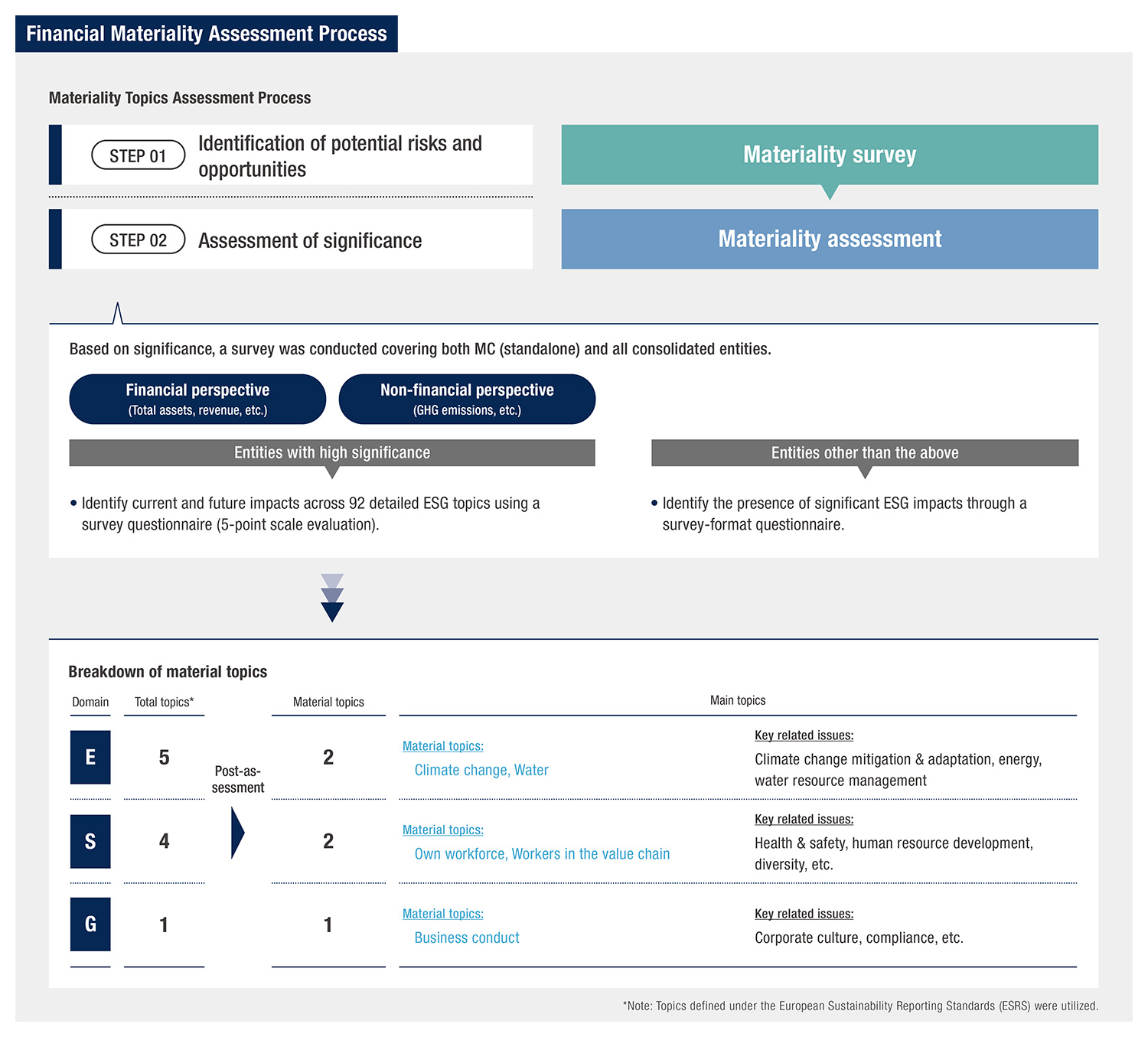
(1) Assessment of Financially Material Sustainability Topics
We have continued to strengthen our management of environmental and social risks, recognizing that appropriately addressing these risks and enhancing related disclosure are essential to sustaining our businesses amid an uncertain operating environment. We also believe that these efforts can contribute to a lower cost of capital.
In preparation for the introduction of sustainability disclosure under Sustainability Standards Board of Japan standards in our Securities Report from FY2026, our finance and accounting functions have led a cross-functional process, working with the relevant departments responsible for areas including climate change and human capital. Through this process, we have analyzed, assessed, and identified sustainability-related matters with potential financial materiality in accordance with the applicable standards.
In identifying financially material topics, we assessed both MC on a non-consolidated basis and all consolidated businesses.
Businesses assessed as particularly significant in terms of their potential financial, environmental, or social impacts were subject to a detailed assessment of the potential impacts associated with individual ESG topics across their value chains. For the remaining businesses, we used questionnaires to identify potentially significant ESG impacts that may arise.
Based on this work, we analyzed the financial risks and opportunities across MC and identified five material topics for sustainability disclosure. These topics are also consistent with the materiality that MC has identified historically. Based on the results of this analysis and assessment, we are preparing the relevant disclosures for inclusion in our FY2026 Securities Report while continuing to advance initiatives that support sustainable growth.
(2) Final Thoughts
The progress made to date gives me confidence in our path toward achieving the targets set out in CS 2027. At the same time, it remains essential that we continue improving both growth and capital efficiency on a sustained basis through our Enhance, Reshape, and Create initiatives.
In an increasingly uncertain environment, identifying and developing new sources of growth is never easy. Against a backdrop of heightened geopolitical and macroeconomic uncertainty, it is all the more important that we steadily advance our growth initiatives while responding to changes with greater agility.
We will continue to engage openly with our shareholders and investors as we work to meet their expectations and enhance corporate value.