Human Rights: Structure
Structure
Within MC’s management framework, human rights initiatives are overseen by the Corporate Functional Officer (CSEO) and Member of the Board/Corporate Functional Officer (Human Resources, Global Planning & Coordination, IT). The Sustainability Department and Global Human Resources Department develop and draft related policies and measures. Following deliberations by the Sustainability Committee and Human Resources Development Committee, items are submitted to or reported to the Executive Committee and the Board of Directors.
Framework of Initiatives
Protecting human rights and ensuring a sustainable supply chain are fundamental to supporting our business activities. MC identifies and analyzes potential negative impacts of our operations on human rights and the environment and undertakes the following initiatives.
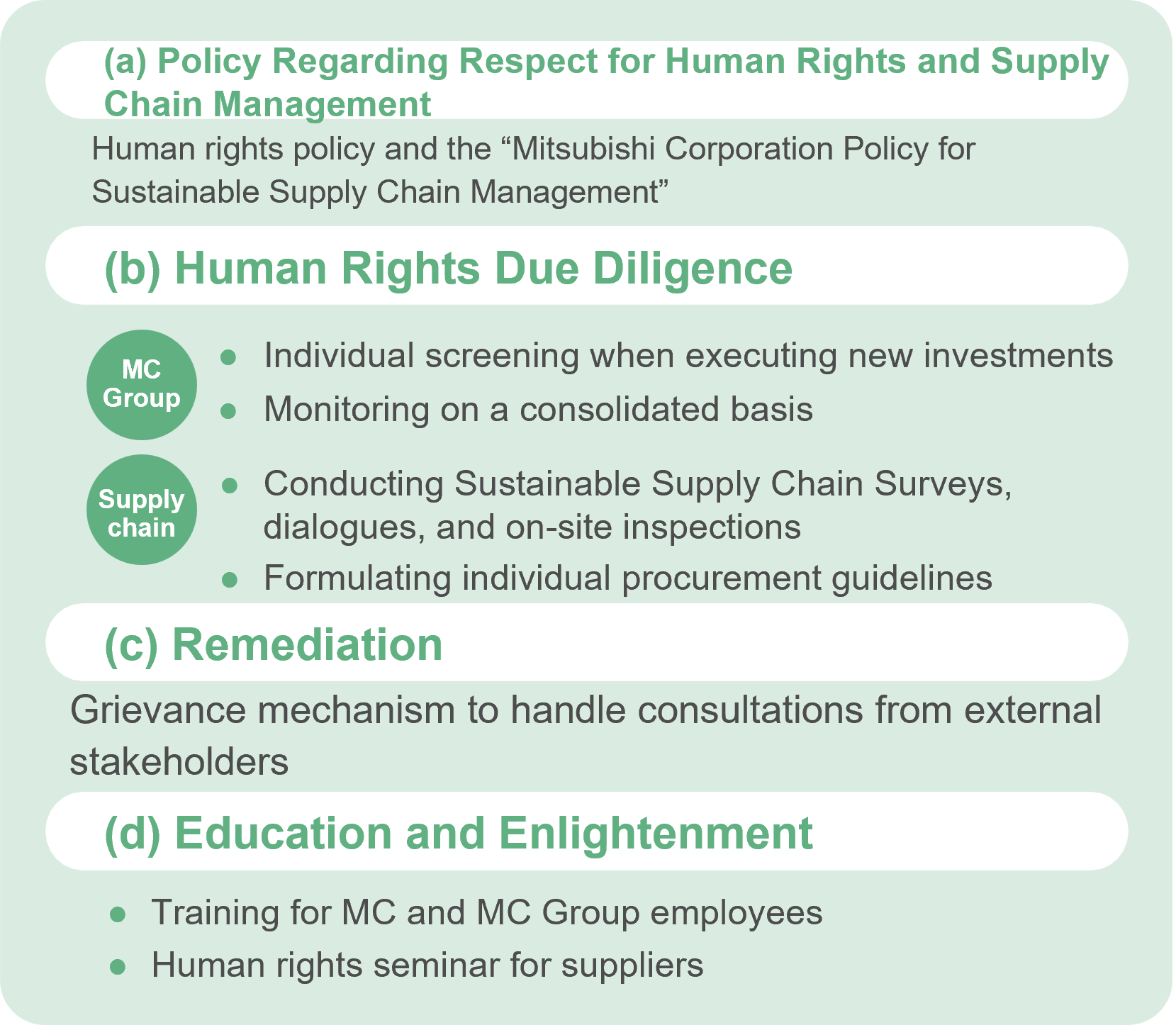
(a) Policy Regarding Respect for Human Rights and Supply Chain Management
MC has formulated a Human Rights Policy that organizes and clarifies our approach, serving as the basis for specific initiatives to promote respect for human rights. All MC operating companies share this common philosophy. Regarding labor practices, MC adopts the International Labour Standards of the International Labour Organization (ILO) as the regulatory framework underpinning the compliance requirements set out in our Code of Conduct. Furthermore, to strengthen human rights efforts across MC on a consolidated basis, we include questions related to human rights—such as the existence of human rights policies and identification of potential risks—in our annual survey for collecting sustainability-related information from subsidiaries and affiliates.
(b) Human Rights Due Diligence
Business Management
When reviewing investment and financing proposals, MC conducts a comprehensive screening process that considers not only economic factors, but also ESG impacts. From a human rights perspective, MC’s assessments are guided by risks that must be addressed based on two key dimensions: severity (including scale, scope, and how remediable the risk may be) and likelihood (considering the situation in each country, industry, and procurement region). MC’s risk management approach is informed by the UN Guiding Principles on Business and Human Rights, the International Finance Corporation (IFC) Guidelines, and the Japan Bank for International Cooperation (JBIC) Guidelines for Confirmation of Environmental and Social Considerations. Through consolidated environmental and social surveys, MC not only screens new investment and exit proposals, but also works to improve practices within existing operating companies by monitoring their management practices. Looking ahead, MC will strengthen its human rights and environmental due diligence on a consolidated basis by expanding the scope of items reviewed and engaging in direct communication with operating companies.
Trading Business
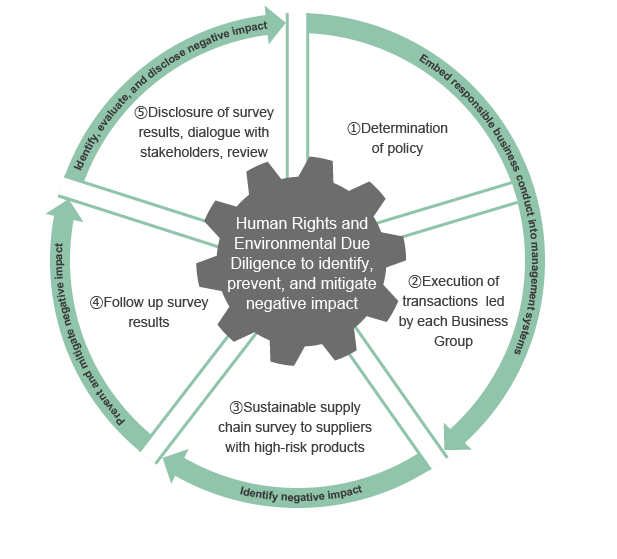
In our trading business, the Mitsubishi Corporation Policy for Sustainable Supply Chain Management outlines actions to address human rights, labor rights, environmental issues, and other related issues. MC expects its suppliers to understand, support, and implement this policy. In addition, MC conducts annual human rights and environmental due diligence across its supply chain through the Mitsubishi Corporation Sustainable Supply Chain Survey.
Human Rights and Environmental Due Diligence Process for Trading Business
(c) Remediation
Details regarding MC's initiatives are availableConsultation Desk for External Stakeholders.
(d) Education and Enlightenment
Details regarding MC's initiatives are availableEngagement.
Engagement
Employee Training
We provide training programs—such as those tailored for specific management levels, new employees, and trading practices—focused on our corporate philosophy, including respect for human rights and relevant guidelines.
Dialogue, Site Visits, and Other Engagements with Group Companies
Dialogue, Site Visits, and Other Engagements with Group Companies
To address specific issues within our Group, we engage in ongoing dialogue and conduct human rights and environmental due diligence with Group companies. We also collaborate with the Group to share our human rights policies and related initiatives, exchange best practices aligned with the annual theme, and hold Q&A sessions to promote mutual understanding and continuous improvement.
Consultation Desk
Internal Consultation Desk
MC has established various consultation systems, including an internal human rights consultation desk and a whistleblowing system, to ensure that any human rights concerns can be raised. These systems allow concerns to be reported at any time by mail, telephone, or in person. They can be used anonymously and confidentially, ensuring the safety of the informant (no subsequent dismissal or other disadvantageous treatment) and ensuring that matters are handled and investigated by individuals who have no conflict of interest. Solutions are offered with full consideration of the informant’s wishes. Employees are informed about these systems during human rights awareness training at the start of employment, and information related to the systems is posted at all times on MC’s internal bulletin boards. Human rights topics are also included in the annual compliance e-learning program, which all executives and employees—including full-time and part-time employees, secondees, and temporary staff—are required to complete. Additionally, as part of a company-wide compliance program, MC provides human rights training, including information on these systems, to employees who are transferred or seconded to affiliated companies.
In FY2024, MC received a 59 reports through the whistleblowing system, 37 of which were related to human rights issues such as harassment and labor management. Compliance Officers conduct necessary investigations with due consideration to avoid infringing on the rights and reputation of those involved. Investigation results are reported to the Chief Compliance Officer and used to develop and implement measures to prevent recurrence.
Consultation Desk for External Stakeholders
MC conducts human rights and environmental due diligence as part of its commitment to identifying, preventing, and mitigating any human rights violations or negative environmental impacts arising from its business activities. To support this, MC has established and manages a consultation desk that serves as a point of contact for external stakeholders to raise concerns where MC's business activities are causing, or could potentially cause, adverse impacts on human rights and/or the environment.
In FY2025, MC received a total of seven reports through its grievance mechanism. For each reported case, we conducted the necessary investigations and, where applicable, shared our perspective and engaged in efforts toward resolution. The results and progress of these cases are reported to the Chief Sustainability Executive Officer (CSEO).