Governance: Audit & Supervisory Committee
Audit & Supervisory Committee
The Audit & Supervisory Committee consists of five Directors serving as Audit & Supervisory Committee Members and audits Directors’ decision-making processes and the status of business execution in accordance with the Companies Act, other applicable laws and regulations, as well as the Articles of Incorporation and internal rules and regulations of Mitsubishi Corporation (MC).
Full-time Audit & Supervisory Committee Members conduct audits from perspectives based on their extensive experience within MC, while Independent Directors who serve as Audit & Supervisory Committee Members conduct audits based on their diverse expertise and from independent and objective viewpoints, thereby ensuring the soundness of management. In addition to resolving statutory matters, the Committee promotes information sharing through briefings on important matters to each Member and reporting by each Member on the status of their audit activities.
Structure of the Audit & Supervisory Committee
Please refer to “Audit & Supervisory Committee Audits” at the link below for details on the Committee’s structure.
Percentage of Independent Audit & Supervisory Committee Members among Total Audit & Supervisory Committee Members*
*Based on the status as of June 19, 2026

Audit Plans
At the beginning of each fiscal year, the Audit & Supervisory Committee formulates audit plans and identifies key focus areas. In FY2025 (ended March 31, 2026), three priority areas were selected to monitor progress in management and execution.
1. Monitoring of CS 2027:
- Progress on implementation of the new corporate strategy
- Progress of Enhance, Reshape, and Create initiatives
- Impact and effectiveness of newly established company-wide organizations (Capital Alliance Office, CVC Office, AI Solution Task Force)
2. Strengthening Governance of MC on a Consolidated Basis:
- Effectiveness of and adherence to newly adopted rules and monitoring processes (trade practices, IT, and other areas)
- Development of a risk management system and organizational culture that prevents misconduct
- Communication between supervisory groups and operating companies
3. Initiatives to Strengthen Corporate Governance:
- Progress toward enhancing deliberations at the Board of Directors
In FY2026 (ending March 31, 2027), the following three priority areas have been identified, and progress in management and execution is being monitored.
1. Monitoring of CS 2027:
- Progress of Enhance, Reshape, and Create initiatives
- Progress toward achieving high growth and efficiency
- Responses to changes in the business environment
2. Risk Management on a Consolidated Basis (Initiatives to prevent incidents and avoid loss realization):
- Responsiveness to operational risks
- Development and enhancement of the three lines of defense on a consolidated basis
3. Enhancement of Corporate Governance:
- Progress toward enhancing deliberations at the Board of Directors and advisory committees
- Acceleration of decision-making through delegation of authority
- Optimization of head office functions and well-balanced organizational management
Audits of Management Performance
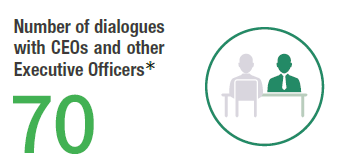
1. Dialogue with Executive Officers
Opportunities were provided for Audit & Supervisory Committee Members, including Independent Audit & Supervisory Committee Members, to engage in discussions with the Chairman of the Board, President and CEO, Senior Executive Vice President, Corporate Functional Officers, business segment CEOs, business division COOs, General Managers of administrative departments within each business segment, the General Manager of Business Development for Japan, the General Manager of the Internal Audit Department, the General Manager of the Corporate Strategy & Planning Department, the General Manager of the CVC Office, the General Manager of the Capital Alliance Office, and General Managers of the Corporate Staff Sections.
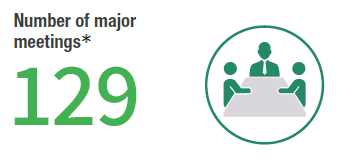
2. Attendance at Important Meetings
In addition to participating in Audit & Supervisory Committee meetings, Members attend Board of Directors meetings in their capacity as Directors. They also take part in key committees, including the Corporate Governance and Nomination Committee and the Compensation Committee. Full-time Audit & Supervisory Committee Members attended meetings of major internal management bodies, such as the Executive Committee and Business Strategy Committee, and provided opinions as necessary. Independent Audit & Supervisory Committee Members participated in Board of Directors meetings after receiving briefings on discussions held in the Executive Committee and other subordinate bodies and provided input as appropriate.
3. On-site Audits and Observations
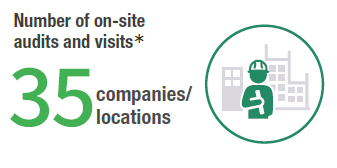
Audit & Supervisory Committee Members proactively conducted on-site audits and visits to overseas and domestic operating companies to gain a clear understanding of local circumstances. When selecting locations, both quantitative factors such as investment amount and net income, and qualitative factors such as the business environment and compliance cases, are considered.
In FY2025 (ended March 31, 2026), Members met with the CEOs and executive officers of 13 operating companies across six overseas locations and 15 domestic operating companies, as well as the heads of two overseas offices. The results of these audits were reported to the Chairman of the Board, the President and CEO, and relevant executive officers.
At least one Independent Audit & Supervisory Committee Member participated in on-site audits and visits to six companies in four overseas countries and 12 domestic operating companies, as well as one overseas office.
4. Reinforcement of Corporate Governance on a Consolidated Basis
In addition to holding dialogues with CEOs and other executive officers of operating companies, quarterly information exchange sessions are arranged with Audit & Supervisory Board/Committee Members of 34 major operating companies in Japan. These members also organize subcommittees to share information and exchange opinions. Training support is provided for individuals scheduled to be assigned as full-time Audit & Supervisory Board/Committee Members at operating companies. Efforts will continue to strengthen corporate governance on a consolidated basis through regular monitoring.
Enhancing the Effectiveness of the Audit & Supervisory Committee
MC conducts annual evaluations of the effectiveness of the Board of Directors to continuously improve corporate governance. The Audit & Supervisory Committee focused on the following matters, referring to issues identified in the evaluation.
1. Strengthening Collaboration with Independent Directors
Independent Directors who are not Audit & Supervisory Committee Members also attend meetings between Committee Members and executive management. Collaboration among Independent Directors is further strengthened through opportunities to exchange opinions, such as preliminary briefings on matters submitted to the Board of Directors and meetings of Independent Directors.
2. Enhancing the Effectiveness of the Audit & Supervisory Committee
To enhance audit effectiveness, the Audit & Supervisory Committee conducted mid-year and year-end reviews of audit progress, focusing on key audit areas. It also carried out a self-evaluation through a member survey and discussions of the results. Based on these efforts, the Committee reviewed its auditing methods and deliberated on matters to follow up in the next fiscal year. As a result, it was confirmed that the Committee’s audits functioned appropriately and effectively, and initiatives to further enhance effectiveness will continue to be considered on an ongoing basis.
Enhancement of Tripartite Audits
The Audit & Supervisory Committee worked to strengthen cooperation with Independent Auditors and the Internal Audit Department to assess the Company's situation and improve audit effectiveness.
1. Collaboration with Independent Auditors / Evaluation of Independent Auditors
The Committee engaged with Independent Auditors through briefings on accounting audit plans, audit reports for quarterly results, and monthly meetings. It also exchanged opinions with Independent Auditors of operating companies in Japan and overseas.
For performance evaluations, the Committee monitored evaluation data throughout the fiscal year using regular audit reports and other sources. At the end of FY2025 (ended March 31, 2026), it held an evaluation conference and concluded that the Independent Auditors performed audits appropriately and professionally. Based on this assessment, the Committee resolved to reappoint them.
2. Collaboration with the Internal Audit Department
The Internal Audit Department and Full-time Audit & Supervisory Committee Members held monthly meetings to exchange views on internal audit reports. The Internal Audit Department also presented quarterly audit results at Committee meetings.
In addition, Committee Members attended liaison meetings of internal auditors from 36 major operating companies in Japan organized by the Internal Audit Department, while the General Manager of the Internal Audit Department attended liaison meetings with Audit & Supervisory Board/Committee Members of the same major domestic operating companies. These sessions facilitated information sharing and the exchange of opinions among all parties.