Contributing to Decarbonized Societies
Contributing to Decarbonized Societies
MC contributes to the realization of decarbonized societies by reducing greenhouse gas (GHG) emissions and delivering products and services that support decarbonization throughout the transition period.
Related SDGs Themes

Action Plan for This Material Issue
MC regards achieving a decarbonized society as a critical corporate priority and is actively promoting carbon reduction and decarbonization through its business activities under the Materiality theme “Contributing to Decarbonized Societies." By leading this transformation and linking it to business growth, MC aims to create MC Shared Value. In addition to advancing its own decarbonization goals— to reduce GHG emissions by 30% to half by FY2030 (compared to FY2020) and achieving net zero by 2050)—MC will contribute to societal decarbonization by generating avoided emissions through EX-related investments totaling approximately 1.2 trillion yen over the three-year period of Midterm Corporate Strategy 2024.
Renewable Energy Development
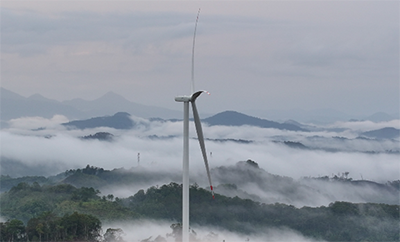
MC is expanding its renewable energy business both in Japan and overseas to help achieve a decarbonized society.
As of the end of September 2025, the current generation capacity on a net equity basis), including assets under construction, stands at 4.1 GW.
Initiatives in Europe for the Promotion of Renewable Energy
Eneco, a Dutch integrated energy company, operates power generation, power and gas trading, power and gas retail, and district heating businesses across the Netherlands, Belgium, and Germany, with renewable energy at its core. With the third-largest customer base in the Netherlands, Eneco manages approximately 2.8 GW of renewable energy assets (as of March 2025). Since 2007, Eneco has led the development of renewable energy ahead of its competitors and established itself as a green brand by providing consumers with 100% green energy (including green certificates) since 2011. Known for its customer-focused approach, Eneco launched its One Planet Plan in 2021, aiming for carbon neutrality by 2035. This commitment covers Scope 1 and 2 emissions from its own operations and Scope 3 emissions across its value chain, including power and gas retailing and heat supply. Eneco is widely recognized domestically and internationally for its proactive climate action.
MC seeks to contribute to a sustainable society by achieving triple-value growth—economic, societal, and environmental—through leveraging Eneco's technology and expertise to accelerate renewable energy development within and beyond Europe. By combining Eneco's strong customer base with MC's various products and services, MC aims to enhance energy management solutions for Eneco's customers.
The power business is undergoing a major transition driven by decentralized power sources, advancements in battery storage, and digital technologies accompanying the rise of renewable energy. In this context, MC, together with its partner Chubu Electric Power, is committed to addressing societal challenges such as the shift to a decarbonized society and global environmental preservation. Both companies will support essential infrastructure and promote innovation through Eneco’s integrated energy services, which combine renewable energy development with cutting-edge digital technology.
Implementation of Next-Generation Energy Supply Chains
MC advances the practical implementation of hydrogen and its derivatives, such as ammonia. The company conducts joint studies with partners at every stage of the value chain, including production, transportation, and usage. In addition, MC is promoting the introduction of Sustainable Aviation Fuel (SAF) in the aviation sector, where electrification and hydrogen-based solutions remain difficult.
Major Progress
- Joint Study by Idemitsu Kosan and Mitsubishi Corporation on Low-Carbon Ammonia
- Mitsubishi Corporation and ExxonMobil Sign Project Framework Agreement to Advance World’s Largest Low-Carbon Hydrogen Project
- Joint Study on the Social Implementation of Hydrogen and Decarbonized Fuels
- Mitsubishi Corporation and 7 Large International Companies Join Forces to Sponsor the Creation of a Global e-NG Coalition
- Par Pacific, Mitsubishi, and ENEOS to Establish Joint Venture for Renewable Fuels in Hawaii
- Mitsubishi and ENEOS to Conduct Front End Engineering Design for Sustainable Aviation Fuel (SAF) Production at the Wakayama Refinery
Supply of Mineral Resources to Promote an Electrified Society
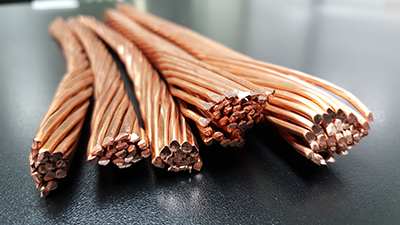
Mineral resources such as copper are essential for renewable energy and electrification, making them critical to achieving a decarbonized society. MC aims to expand its copper business through organic growth opportunities in existing assets—some of which hold the world’s largest copper reserves—by increasing its stake in current operations, acquiring new assets, and leveraging new technologies to improve resource recovery.
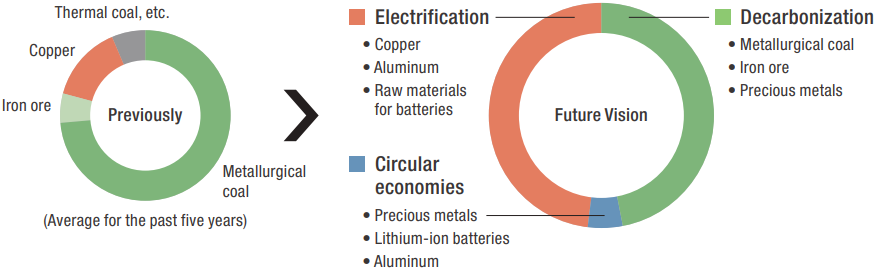
Major Progress
CCUS Initiatives
As part of its commitment to the goals of the Paris Agreement, MC recognizes that Carbon Capture, Utilization, and Storage (CCUS) will play a critical role in achieving these targets. The International Energy Agency (IEA) has indicated that CCUS will play an important role in pathways consistent with the 1.5°C target, and the Intergovernmental Panel on Climate Change (IPCC) has also highlighted the importance of CCUS, particularly in the industrial sector. Similarly, the Intergovernmental Panel on Climate Change (IPCC) has emphasized the importance of technological solutions in this effort. CCUS spans multiple industries, from sectors generating CO2 emissions to those producing end-products such as fuels and chemical materials. MC views CCUS as a significant business opportunity to leverage its collective capabilities across diverse industries. To capitalize on this opportunity, MC is promoting the commercialization of CCUS by establishing a cross-segment task force and a liaison committee to drive collaboration and innovation.
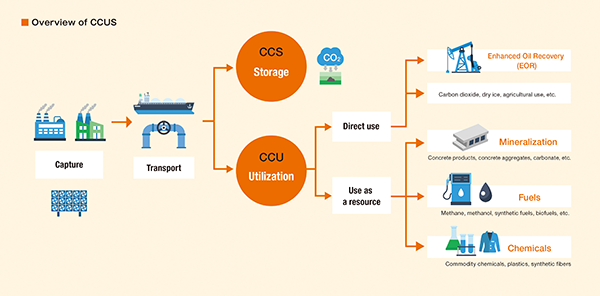
Main Progresses
- MC is conducting a feasibility study to establish an overseas CCS value chain for projects designated as Advanced CCS Projects by JOGMEC for fiscal years 2023, 2024, and 2025.