Stakeholder Engagement: MC’s Primary Stakeholders
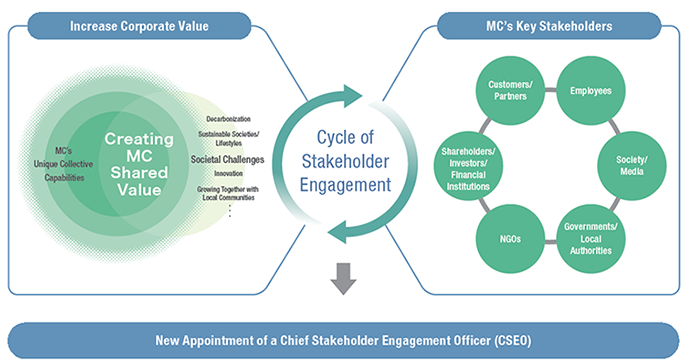
With the Three Corporate Principles as its core philosophy, MC has continued to grow alongside society by addressing global issues. MC seeks to increase its corporate value in the medium to long term amid a global backdrop of rising uncertainty and unpredictability, including geopolitical and economic shifts, changes in industrial landscapes driven by technological innovation, and evolving societal values. To this end, we believe it is vital to accurately understand the demands and expectations of all of our stakeholders through engagement and dialogue, and to reflect these in our Group management.
MC has established a system to reflect stakeholder opinions into company management by incorporating external perspectives into the Board of Directors and its advisory bodies (Corporate Governance and Nomination Committee, Compensation Committee, and International Advisory Committee), as well as the Sustainability Roundtable. With these and other initiatives to engage with its various stakeholders, MC aims to achieve sustainable growth through value creation and by engaging our stakeholders.
Customers and Partners
MC contributes to the development of societies and economies by providing a stable supply of products and services that meet the needs of customers and business partners across a wide range of business areas, from upstream raw material procurement to downstream retail. We also work closely with customers and partners to develop businesses that could not be realized on our own. As a company handling a diverse range of products and services worldwide, ensuring a sustainable supply chain is a key priority for MC.
Examples of Engagement
- Producing websites and corporate brochures in multiple languages
- Receiving and responding to opinions and questions
- Conducting surveys and collaborating with external parties regarding the supply chain
Employees
In response to the increasing diversification and globalization of its businesses, MC is working to support company employees and encourage their success worldwide, with the aim of ”Fostering Vibrant Workplaces That Maximize the Potential of a Diverse Workforce.” This is to establish vibrant workplaces where MC’s diverse and versatile employees, regardless of gender, nationality, or other attributes, are able to demonstrate their unique abilities to the fullest.
Examples of Engagement
- Human resource development
(enhanced talent management, career autonomy, group-wide training initiatives, etc.) - Health and productivity management, diversity management
(including supporting health with internal medical clinics, career support for female employees, etc.) - Conducting regular Employee Awareness Surveys
(These surveys are conducted annually to obtain a snapshot of employee motivation and organizational vitality.) - Dialogue with the MC Staff Union, and information dissemination through MC’s intranet and internal magazine
MC Staff Union
Please refer to theMC Staff Unionpage for details.

Shareholders, Investors, and Creditors
MC strives to gain understanding and support for its business and management strategy through the timely and appropriate disclosure of information and enhancement of disclosure materials, as well as through briefings and individual meetings. At the same time, MC works to maximize corporate value by incorporating the opinions and demands of shareholders and investors obtained through dialogue into its management practices.
Examples of Engagement
- Meetings with institutional investors and analysts
- Communication with shareholders at the Ordinary General Meeting of Shareholders
- Publication of business reports, integrated reports, and sustainability reports
- Quarterly financial results briefings
- Business briefing sessions
- Online seminars with individual investors
- Corporate Governance Report(Principle 5.1 Policy for Constructive Dialogue with Shareholders)
General Public and the Media
We believe that building relationships with society and the media is important for the promotion of our business. Through communication, we strive to ensure their opinions and requests are heard, and gain their understanding and support for our management philosophy, strategies, and stance on social issues.
Examples of Engagement
- Ensure timely and accurate disclosure regarding projects and events that could significantly affect society or people's livelihoods
- Share views from our business perspective that may influence the formation of public opinion
e.g. corporate website, news releases, official social media networks, sponsored events
NGOs and NPOs
We recognize NGOs and NPOs as key stakeholders representing the interests of the planet and its citizens. Feedback from our ongoing and constructive communication with these organizations is incorporated into efforts to improve our initiatives. Moreover, we actively foster collaborations with these groups to address pressing environmental and societal challenges.
Examples of Engagement
- Corporate philanthropic activities focused on protecting biodiversity (such as coral reef conservation worldwide) and addressing climate change (such as rangeland restoration)
Through the Mitsubishi Corporation Foundation for the Americas (MCFA) and the Mitsubishi Corporation Foundation for EMEA Charitable Incorporated Organisation (MCF for EMEA), MC supports initiatives that work towards realizing an inclusive society, empowering the next generation, and conserving the environment.
Governments and Local Authorities
To help address social issues and deliver solutions through our global business operations, we engage in collaboration, joint initiatives, and dialogue with public sector bodies. This includes in business associations, public-private initiatives, and other forums.
Examples of Engagement
- Business association activities:
Dialogues with public sector bodies through organizations such as the Japan Business Federation (Keidanren), the Japan Chamber of Commerce and Industry, the Tokyo Chamber of Commerce and Industry, the Japan Association of Corporate Executives, the Japan Foreign Trade Council, Inc., etc. - Public-private initiatives with public institutions:
Collaborations with and utilization of Japanese government ministries (including the Ministry of Foreign Affairs, the Ministry of Economy, Trade and Industry, the Ministry of the Environment, the Ministry of Land, Infrastructure, Transport and Tourism, etc.), the Japan International Cooperation Agency, and Multilateral Development Banks.